For decades, your alarm clock has been the conductor of your life’s symphony. It dictated when you woke, when you ate, when you moved, and when you finally allowed your brain to switch off. The professional grind, while exhausting, provides a rigid skeletal structure for your physical and mental habits. But when that schedule disappears on day one of retirement, that structure collapses. Without the "forced" movement of a commute or the "forced" social interaction of a meeting, many retirees find their health sliding into a state of inertia.
The "Retirement Health Reset" is not about intense dieting or training for a marathon—though those are fine goals. Instead, it is about consciously rebuilding a new foundation of health that thrives on freedom rather than obligation. When you no longer have to do anything, you must decide what you want to do to ensure your next thirty years are as vibrant as your last thirty. This transition is a psychological and physiological pivot that requires strategy. Here is how to navigate the shift and the ten habits that will define your longevity.
The Physiology of Freedom: Why the Lack of Routine Impacts Your Body
The human body loves homeostasis, but it also thrives on rhythmic patterns known as circadian rhythms. For thirty to forty years, your body was calibrated to a specific cycle. When you retire, the sudden absence of these cues can lead to "Social Jetlag." This phenomenon occurs when your internal biological clock is out of sync with your daily activities, often leading to poor sleep, weight gain, and cognitive fog.
The Trap of the "Permanent Saturday"
The most significant danger in early retirement is treating every day like a Saturday. On a Saturday, you might sleep in, eat a heavy brunch, and sit on the porch. While rejuvenating as a break, this lifestyle as a permanent state leads to muscle atrophy and metabolic slowing. The "Retirement Health Reset" begins by acknowledging that while you are retired from your job, you cannot retire from your biology. Your body still requires movement, nutrient density, and mental stimulation to prevent the rapid onset of age-related decline.
Redefining Stress and Cortisol
We often think of retirement as the end of stress, but the total absence of stress can be just as harmful as too much of it. The body needs "eustress"—positive stress—to keep the immune system and the brain sharp. Without the pressure of deadlines, we must find new ways to challenge our cardiovascular systems and our problem-solving skills. The habits we build now are the tools we use to provide that healthy level of stimulation.
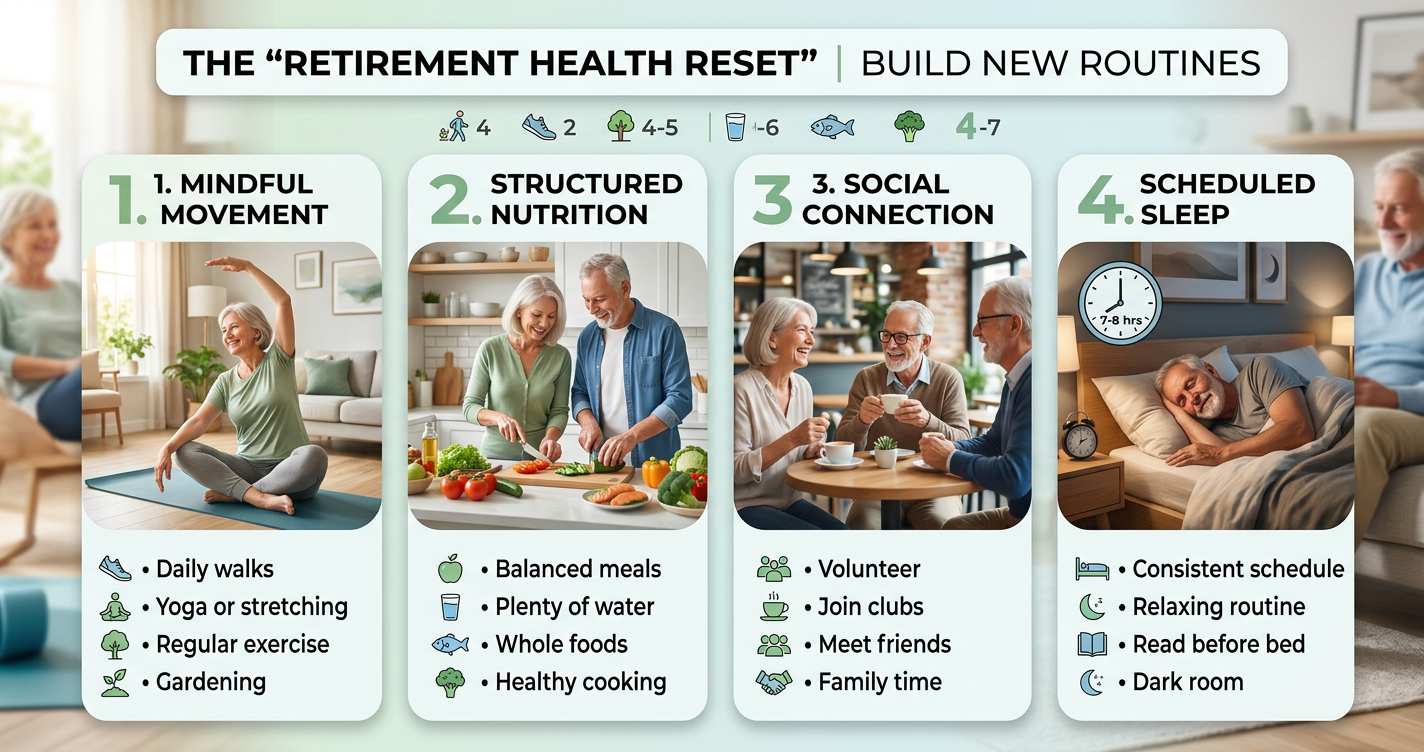
Habit 1: The Consistent Wake-Up Window: You don't need to wake up at 6:00 AM anymore, but waking up within the same 60-minute window every day stabilizes your hormones and improves sleep quality.
Habit 2: Sunlight Before Screens: Getting 10 minutes of natural light in your eyes first thing in the morning resets your circadian rhythm, ensuring you feel tired at the right time in the evening.
Habit 3: The "Non-Negotiable" Morning Movement: Whether it's a walk or yoga, movement must happen before the day's leisure activities begin.
Building the Physical Foundation: Movement and Nutrition Without the Office
When you worked, you likely walked to your car, paced during calls, or navigated a large office building. This "NEAT" (Non-Exercise Activity Thermogenesis) often accounts for more burned calories than a formal workout. In retirement, your NEAT often plummets. Rebuilding your health requires a two-pronged approach: deliberate physical training and a complete overhaul of your relationship with food, which is no longer tied to "lunch breaks."
The Muscle-Centric Approach to Aging
Sarcopenia, or age-related muscle loss, is the silent enemy of the retiree. After age 50, we lose about 1-2% of our muscle mass per year if we aren't active. This isn't just about aesthetics; muscle is your metabolic engine and your insurance policy against falls. The "Retirement Health Reset" prioritizes resistance training over steady-state cardio. You need to lift, pull, and push things to signal to your body that it still needs to be strong.
Nutrition in a Timeless World
In the working world, meals are often rushed or skipped. In retirement, the danger is "grazing." Because the kitchen is always ten steps away, retirees often find themselves eating out of boredom rather than hunger. A key habit in this reset is the "Meal Architecture" habit—planning exactly when you will eat to avoid the blood sugar rollercoasters that lead to afternoon fatigue.
Habit 4: The Protein Priority: As we age, our bodies become less efficient at processing protein. Aim for 25-30 grams of protein at every meal to maintain muscle mass.
Habit 5: Functional Strength Training: Twice a week, engage in movements that mimic real life—squats (sitting down/standing up), lunges (getting off the floor), and carries (hauling groceries).
Habit 6: The "Walking Meeting" with Yourself: Replace your old commute time with a 30-minute brisk walk. This preserves cardiovascular health and provides a transition period for your brain.
Habit 7: Hydration Architecture: Without an office water cooler, many retirees forget to drink. Drink a full glass of water before every coffee or tea to ensure metabolic efficiency.
The Cognitive and Social Reset: Protecting the Mind
Perhaps the most overlooked aspect of retirement health is the brain. Your career likely provided a constant stream of complex problems, social nuances, and learning opportunities. When that disappears, the brain can begin to prune neural pathways that are no longer being used. Cognitive decline is not an inevitability of aging; often, it is a result of "disuse atrophy."
Combating the Loneliness Epidemic
Work provides a "low-stakes" social environment. You see people, exchange pleasantries, and feel part of a tribe. When you retire, your social circle can shrink overnight. Isolation is a physiological stressor that increases the risk of heart disease and dementia. A vital habit in your reset is the intentional cultivation of a new "social portfolio." This requires more effort than it did at the office, but the health dividends are enormous.
Deep Work for Leisure
The brain needs "deep work"—tasks that require intense concentration. Passive consumption, like watching television or scrolling through social media, does not provide the neuroplasticity required to keep the mind young. Learning a new language, mastering an instrument, or even complex gardening requires the brain to build new bridges between neurons. This is the ultimate "Reset" for your mental longevity.
Habit 8: The Social Appointment: Schedule at least three face-to-face social interactions per week. This could be a club, a volunteer shift, or a standing coffee date.
Habit 9: The "New Skill" Sprint: Dedicate 20 minutes a day to learning something you are bad at. The frustration of learning is actually the feeling of your brain growing.
Habit 10: The Evening Reflection: Without a "clock-out" time, the days can blur together. Spend five minutes each night journaling or reviewing your day. This practice of reflection maintains a sense of time and purpose, preventing the "drift" that often characterizes unhealthy retirements.
Conclusion: The Long-Term Vision
Transitioning into retirement is one of the most significant life changes you will ever experience. By implementing the "Retirement Health Reset," you aren't just filling time; you are engineering a lifestyle that supports your vitality. These ten habits—ranging from protein intake to social appointments—act as the new scaffolding for your life. The work schedule may have disappeared, but your commitment to your own well-being is a full-time job that offers the best benefits package in the world: a long, healthy, and purposeful life.