In a world increasingly obsessed with wellness, it is easy to assume that if you are physically active, maintain a healthy weight, and fill your plate with vibrant colors, you are immune to nutritional gaps. We often equate the absence of disease with the presence of optimal health. However, clinical nutritionists and healthcare professionals are seeing a rising trend: individuals who appear to be the "picture of health" are testing positive for significant vitamin and mineral deficiencies. This paradox raises a critical question: why is a healthy diet sometimes not enough?
The reality is that modern health is a complex interplay of environmental factors, biological individuality, and the evolving nature of our food supply. Even those who prioritize organic fruits and veggies may be fighting an uphill battle against soil depletion and lifestyle stressors. Understanding why healthy people can still have nutrient deficiencies is the first step toward optimizing your vitality and ensuring your body has the raw materials it needs to thrive, not just survive.
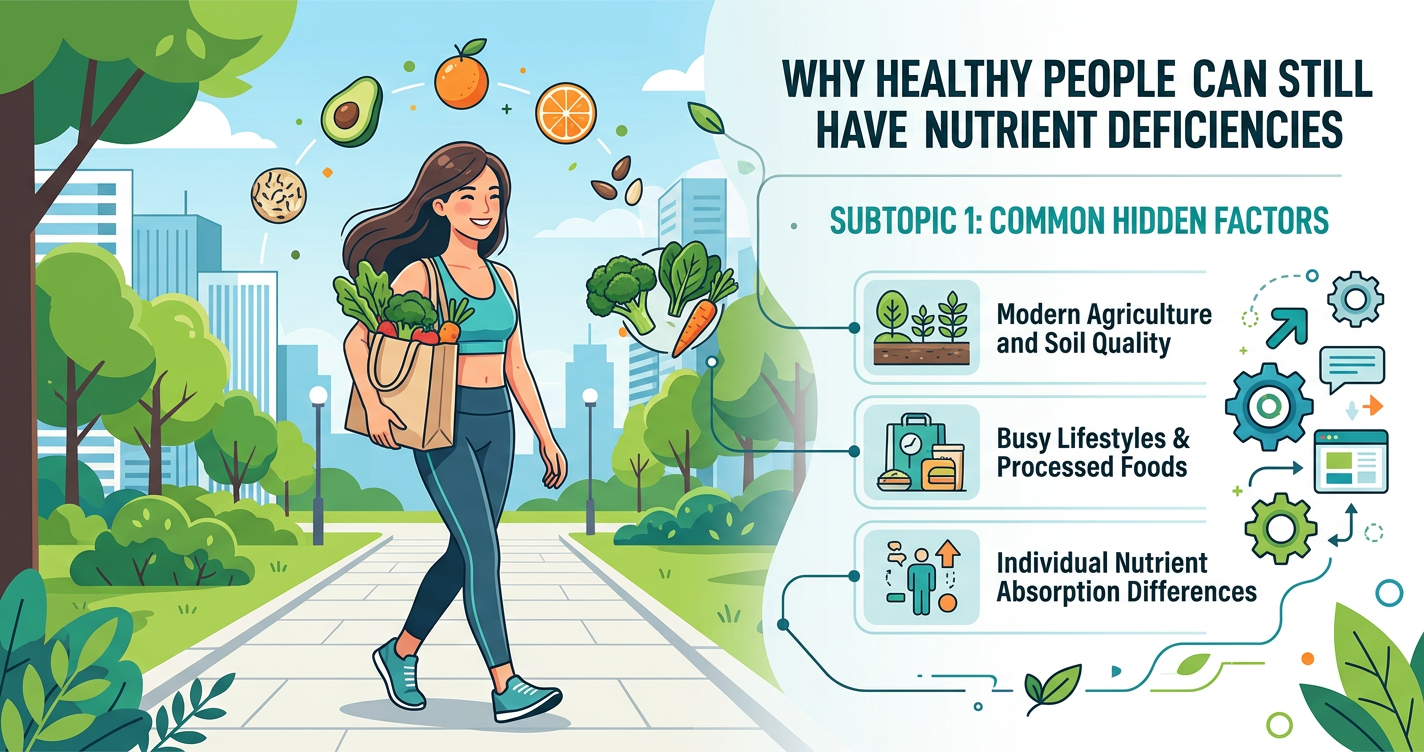
1. The Hidden Impact of Modern Agriculture and Soil Depletion
One of the most significant reasons why a diet rich in plant-based foods may fall short is the decline in the nutritional density of our produce. Several decades ago, an apple or a bunch of spinach contained significantly higher concentrations of essential minerals than they do today. The industrialization of agriculture has prioritized yield, pest resistance, and shelf life over the nutrient profile of the soil. When the soil lacks minerals, the crops grown in that soil cannot absorb them, leading to a "dilution effect" where we get more calories but fewer micronutrients.
The Decline of Mineral Content
Studies comparing historical food composition data have shown consistent declines in calcium, phosphorus, iron, riboflavin, and vitamin C across dozens of common fruits and veggies. For example, to get the same amount of Vitamin A from an orange in the 1950s, you might need to eat several oranges today. For the health-conscious individual, this means that even if you are meeting your daily servings of greens, the actual chemical payout of those greens may be lower than what your body requires for optimal enzymatic function.
The Problem with Long-Distance Transport
Furthermore, the modern supply chain plays a role. Many "fresh" items in the grocery store are picked before they are ripe to withstand thousands of miles of travel. Since many nutrients develop during the final stages of ripening on the vine or tree, premature harvesting results in a lower nutrient peak. By the time these items sit in a warehouse, a truck, and finally your refrigerator, their vitamin content—particularly heat-sensitive and light-sensitive vitamins like B-complex and Vitamin C—can degrade significantly.
Soil Health: Over-farming leads to a lack of selenium, magnesium, and zinc in the earth.
Selective Breeding: Farmers often choose varieties that grow fast and look good, rather than those that are nutrient-dense.
Pesticide Use: Some pesticides can interfere with a plant's ability to take up certain minerals from the soil.
2. Biological Barriers: Absorption, Genetics, and Gut Health
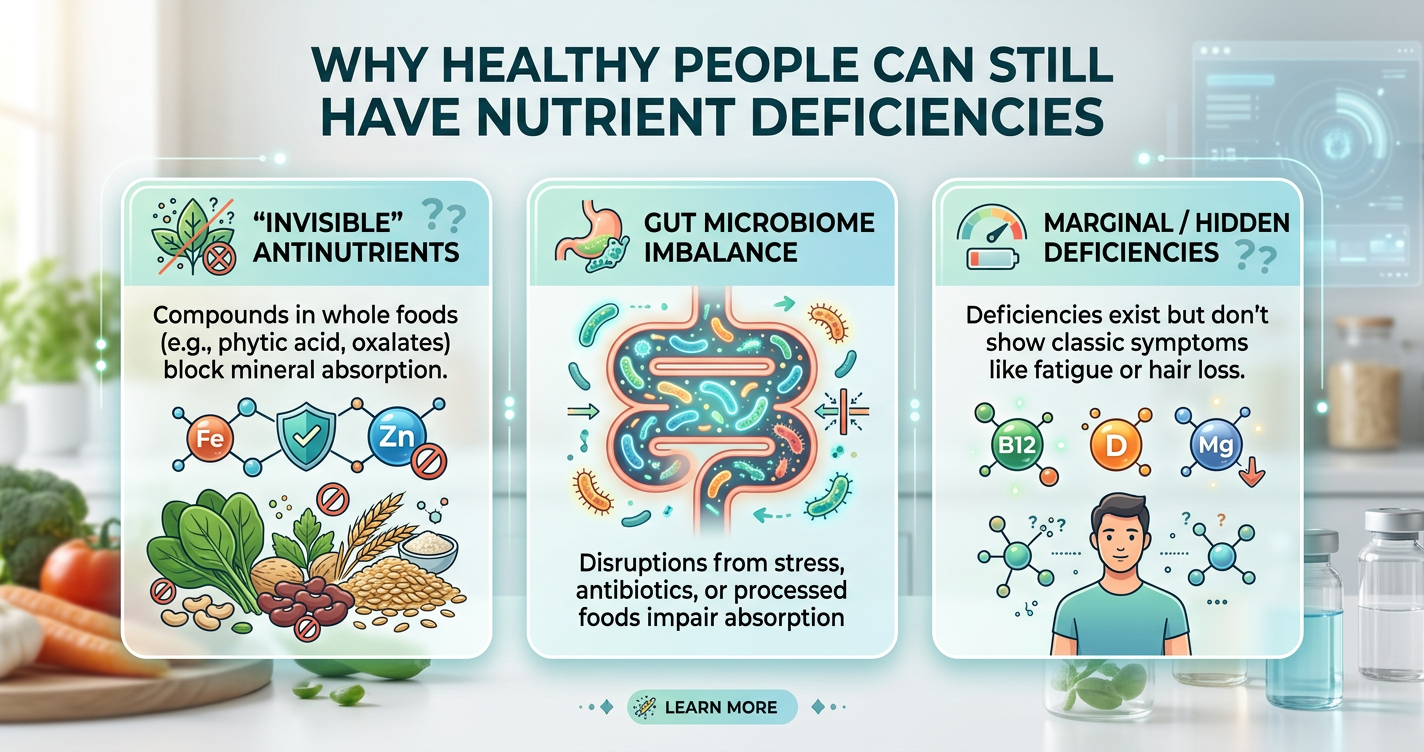
Even if you managed to source the most nutrient-dense produce on the planet, your body still has to successfully break down, absorb, and transport those nutrients into your cells. This is where the "healthy" individual often runs into trouble. Good health on the outside does not always reflect the state of the internal digestive environment. Nutrient deficiencies often stem not from a lack of intake, but from a failure of absorption.
The Role of the Gut Microbiome
The gut is the gateway to health. If you have underlying inflammation, food sensitivities (like undiagnosed celiac or non-celiac gluten sensitivity), or an imbalance in gut bacteria (dysbiosis), your ability to absorb nutrients like B12, iron, and magnesium is compromised. Many "healthy" eaters consume high amounts of fiber, which is generally good, but in some individuals, an over-reliance on raw greens and legumes can lead to digestive distress that inhibits nutrient uptake.
Genetic Predispositions and Polymorphisms
We must also consider the role of genetics. Variations in our DNA, known as Single Nucleotide Polymorphisms (SNPs), can drastically change how our bodies process vitamins. A common example is the MTHFR gene mutation, which affects how the body converts folic acid and folate into its active form, methylfolate. A person with this mutation could eat a mountain of leafy greens and still be functionally deficient in folate because their body cannot utilize it efficiently. Similarly, some people are genetically "poor converters" of beta-carotene into active Vitamin A, meaning their reliance on carrots and sweet potatoes might not be meeting their cellular needs.
Lifestyle Stressors and Nutrient "Theft"
Even a healthy lifestyle can be stressful. High-intensity exercise, while beneficial, increases the body’s demand for antioxidants and minerals like magnesium and zinc to repair tissue and manage oxidative stress. Furthermore, common lifestyle "thieves" such as caffeine, alcohol, and certain medications (like birth control or acid blockers) can deplete the body's stores of B vitamins and minerals. If you are a high-achiever who works hard and plays hard, your nutrient "burn rate" might be higher than what your diet can replenish.
3. Bridging the Gap: Functional Testing and Smart Supplementation
Acknowledging that a perfect diet might still leave gaps is not an admission of failure; it is an evolution of health strategy. To move beyond the paradox of the "unhealthy healthy person," we must shift from a generalized approach to a personalized one. This involves moving away from guesswork and toward data-driven wellness.
The Importance of Targeted Testing
Standard blood panels often look for "normal" ranges, which are designed to identify clinical disease rather than optimal performance. To truly understand your nutrient status, functional testing—such as intracellular micronutrient testing or organic acids testing—is often necessary. These tests look at how nutrients are actually functioning inside your cells. You might find that while your blood levels of a nutrient look fine, your cells are actually starving for it, indicating a transport or utilization issue.
The Role of Supplements in a Modern World
While "food first" should always be the motto, supplements have become a necessary tool for many to maintain peak health. The goal of supplementation is not to replace fruits and veggies, but to provide a concentrated insurance policy against soil depletion and high metabolic demands. For example, Vitamin D is nearly impossible to get in sufficient quantities from food alone, and many people—even those who spend time outdoors—remain deficient due to geographic location or skin melanin levels.
Quality Matters: Not all supplements are created equal. Bioavailability—the ease with which a nutrient is absorbed—varies wildly between cheap synthetic forms and high-quality, chelated, or methylated versions.
Synergy: Nutrients work in teams. For instance, taking Vitamin D3 without Vitamin K2 can lead to calcium being deposited in the arteries instead of the bones.
Consistency: Nutritional status is built over time. Occasional use of a multivitamin is rarely enough to correct a long-standing deficiency.
Crafting a Resilient Nutrition Plan
To ensure you are truly nourished, focus on variety and preparation. Rotating your greens ensures a wider spectrum of phytonutrients. Cooking certain vegetables can actually make their nutrients more bioavailable (like the lycopene in tomatoes or the minerals in spinach), while eating others raw preserves heat-sensitive vitamins. By combining a diverse, whole-food diet with professional-grade supplements and regular functional testing, you can bridge the gap between "looking healthy" and "being healthy."
In conclusion, nutrient deficiencies in healthy people are not a myth—they are a byproduct of our modern environment. By staying informed about soil quality, prioritizing gut health, and utilizing smart supplementation, you can protect your vitality for the long term. Remember, your body is a high-performance machine, and even the best machines require the right fuel in the right forms to keep running at their best.