The Persistent Allure of Nutritional Misinformation
In the digital age, information travels faster than a heartbeat, but unfortunately, misinformation often travels even faster. When it comes to human health, nutrition is perhaps the most contested and confusing field of study for the average consumer. Despite decades of peer-reviewed research and the advancements of clinical dietetics, several nutritional myths remain deeply embedded in our collective consciousness. These myths are often fueled by "wellness" influencers, predatory marketing, and a fundamental misunderstanding of human physiology. To truly achieve long-term health, we must strip away the anecdotal evidence and look at what the science actually says about how our bodies process fuel.
The danger of these myths isn't just that they lead to ineffective dieting; it’s that they create a dysfunctional relationship with food. When we view eating through the lens of fear or arbitrary restriction based on false premises, we invite stress and metabolic inflexibility. Understanding the mechanisms of nutrition—from macronutrient ratios to the insulin index—is the first step in reclaiming your health from the noise of the internet. In this deep dive, we will dismantle five of the most pervasive nutrition myths that refuse to die, providing you with the scientific clarity needed to make informed choices for your body.
Myth 1: Carbs are Inherently Fattening
Perhaps no myth has been more damaging to the public’s dietary habits over the last two decades than the idea that carbohydrates are the primary cause of weight gain. This misconception stems from a simplified understanding of the carbohydrate-insulin model of obesity. The theory suggests that carbohydrates spike insulin, and because insulin is a storage hormone, it automatically leads to fat accumulation. While insulin does play a role in fat storage, it is not the sole arbiter of body composition.
The truth is that weight gain is primarily a byproduct of a sustained caloric surplus. If you consume more energy than your body requires for its daily functions and physical activity, that energy will be stored, regardless of whether it comes from fat, protein, or carbohydrates. In fact, many long-lived populations, such as those in the "Blue Zones," consume diets high in complex carbohydrates like sweet potatoes, legumes, and whole grains. The key distinction lies in the quality of the carbohydrate. Refined sugars and flours lack fiber and micronutrients, leading to rapid blood sugar spikes and crashes that increase hunger. However, complex carbohydrates are essential for thyroid function, brain health, and athletic performance.
Fiber Content: Complex carbs provide the prebiotic fiber necessary for a healthy gut microbiome.
Glycogen Storage: Your muscles and liver store carbohydrates as glycogen, which is the preferred fuel source for high-intensity exercise.
Satiety: Whole-food carbohydrate sources are high in volume and water, helping you feel full on fewer calories.
Myth 2: You Must Eat Every 2-3 Hours to "Stoke the Metabolic Fire"
The idea that frequent, small meals speed up your metabolism is a staple of 1990s bodybuilding culture that has stubbornly persisted. The logic was that the Thermic Effect of Food (TEF)—the energy required to digest nutrients—would keep your metabolic rate elevated throughout the day. While it is true that digestion burns calories, the total TEF is determined by the total caloric intake and the macronutrient composition of those calories, not the frequency of the meals.
If you eat 2,000 calories in two meals or six meals, the total energy expended on digestion remains essentially the same. Furthermore, constant grazing can actually be detrimental for some individuals. Every time you eat, you trigger an insulin response and pause the process of lipolysis (fat burning). Constant eating also prevents the body from entering a state of autophagy—a cellular "cleanup" process that occurs during periods of fasting. For many, fewer, larger meals lead to better satiety and a more stable relationship with hunger cues.
Deconstructing the "Clean Eating" and Detox Fallacies
The modern wellness industry has popularized the terms "clean eating" and "detoxification" to the point where they have become synonymous with health. However, these terms lack clinical definitions and often serve as a gateway to orthorexia—an unhealthy obsession with eating only foods deemed "pure." By categorizing foods into "good" and "bad," we ignore the nuance of nutritional density and the importance of psychological flexibility in dieting.
Myth 3: Your Body Needs a "Detox" or "Cleanse"
The concept of "detoxing" via juice cleanses, teas, or restrictive protocols is one of the most successful marketing scams in the nutrition world. The human body is equipped with a highly sophisticated, built-in detoxification system that works 24 hours a day. Your liver, kidneys, lungs, skin, and lymphatic system are constantly filtering out metabolic waste and environmental toxins. There is no scientific evidence that drinking only green juice for a week "flushes" toxins from your system.
In fact, many detox diets are counterproductive. They are often severely lacking in protein and essential fats, which the liver actually requires to perform Phase I and Phase II detoxification pathways. Rapid weight loss during a "cleanse" is almost entirely water weight and muscle glycogen depletion, not fat loss. Instead of looking for a quick fix, the best way to support your body's natural detoxification is to provide it with the raw materials it needs: high-quality protein, plenty of water, and a variety of antioxidants from colorful vegetables.
Myth 4: "Fat-Free" and "Low-Fat" Options are Healthier
The low-fat craze of the 1980s and 90s was perhaps the greatest dietary failure in modern history. As food manufacturers stripped fat out of products, they realized the food tasted like cardboard. To compensate, they added massive amounts of sugar, high-fructose corn syrup, and artificial thickeners to maintain palatability. This shift coincided with a dramatic rise in type 2 diabetes and obesity globally.
Dietary fat is essential for life. It is a structural component of every cell membrane in your body, it’s required for the absorption of fat-soluble vitamins (A, D, E, and K), and it is the precursor for vital hormones, including testosterone and estrogen. Furthermore, fats provide a sense of satiety that keeps you full between meals. Choosing a full-fat Greek yogurt over a "fat-free" version laden with fruit preserves and sugar is almost always the better choice for metabolic health and appetite control.
Saturated Fats: Long vilified, recent meta-analyses show that saturated fats from whole foods (like eggs or coconut) do not have the direct link to heart disease once claimed, provided they are part of a balanced diet.
Monounsaturated Fats: Found in olive oil and avocados, these are heart-healthy and anti-inflammatory.
Omega-3 Fatty Acids: Essential for brain health and reducing systemic inflammation.
Myth 5: All Calories are Created Equal
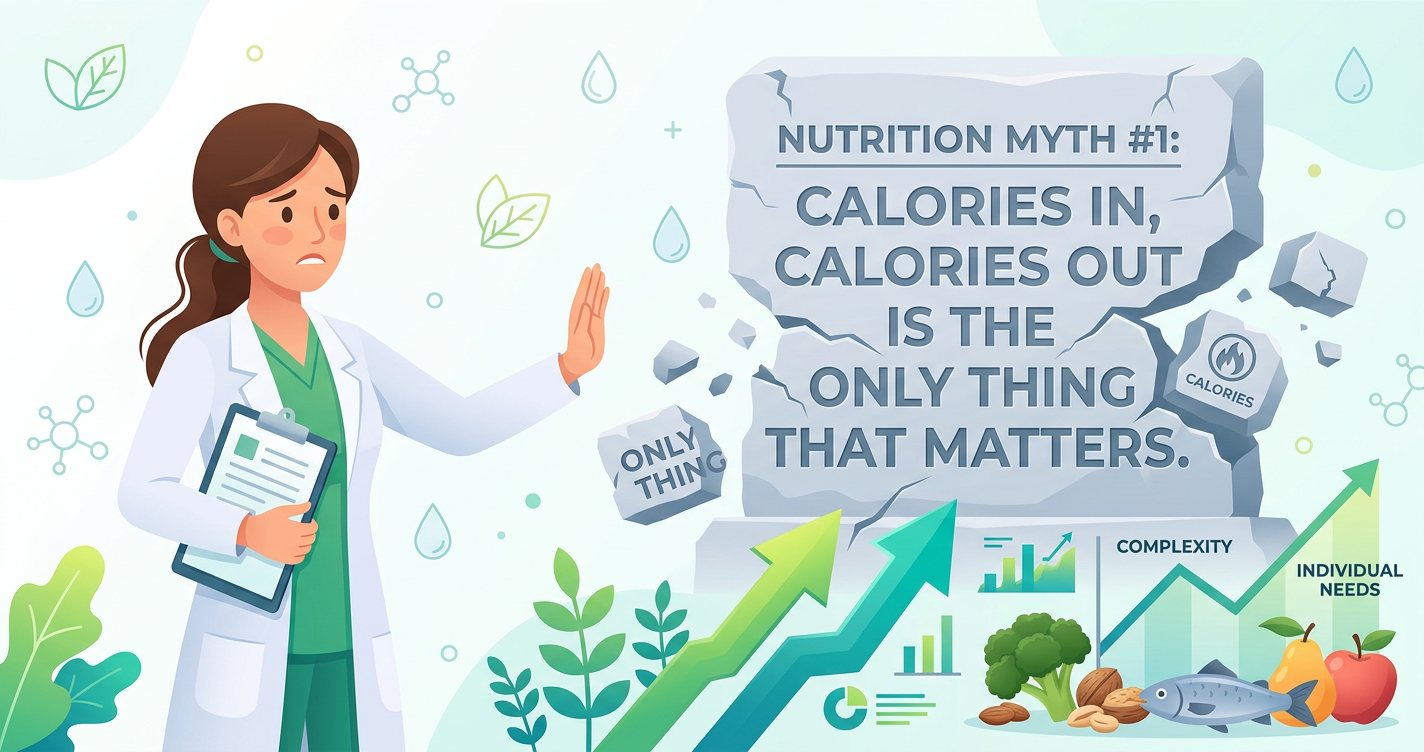
While the laws of thermodynamics dictate that energy balance (calories in vs. calories out) is the primary driver of weight change, the "a calorie is a calorie" mantra is an oversimplification that ignores human biochemistry. From a pure physics perspective, 100 calories of broccoli and 100 calories of gummy bears are the same. However, from a metabolic, hormonal, and neurological perspective, they couldn't be more different.
Different foods have different effects on our hormones. Protein, for instance, has a much higher thermic effect than fats or carbs, meaning you burn more energy just processing it. It also triggers the release of peptide YY, a hormone that signals fullness. Conversely, liquid sugar (like soda) does not trigger the same satiety signals, leading to overconsumption. Furthermore, the fiber in whole foods slows down the absorption of glucose, preventing the insulin spikes that favor fat storage. When we focus only on the number and ignore the source, we set ourselves up for metabolic dysfunction and constant hunger.

Building a Sustainable, Evidence-Based Foundation
Now that we have dismantled these common myths, the question remains: what does a truly healthy diet look like? The answer is often less exciting than the "miracle" cures promised by influencers, but it is far more effective. A sustainable diet is one that is based on whole, minimally processed foods, adjusted to your specific activity levels, and—most importantly—one that you can maintain for a lifetime without psychological distress.
The Importance of Protein and Micronutrients
Instead of focusing on what to "cut out," focus on what to "include." Protein should be the anchor of most meals. It is the most satiating macronutrient and is essential for maintaining lean muscle mass, especially as we age. Alongside protein, a diverse array of plants provides the micronutrients and phytochemicals that act as the "software" for your biological systems. These compounds regulate everything from DNA repair to neurotransmitter production.
Bio-Individuality and Context
One of the biggest flaws in nutritional myths is the "one size fits all" approach. Nutrition is highly contextual. An elite marathon runner requires a vastly different carbohydrate intake than a sedentary office worker with pre-diabetes. A teenager going through a growth spurt has different caloric needs than a post-menopausal woman. Understanding your own "bio-individuality"—your genetics, activity level, gut health, and goals—is crucial. There is no perfect diet, only the diet that works for your unique physiology and lifestyle.
Moving Beyond the Scale
Finally, we must redefine what "success" looks like in nutrition. For too long, the bathroom scale has been the sole arbiter of health. True nutritional health is reflected in your energy levels, the quality of your sleep, your cognitive clarity, your digestive regularity, and your blood markers (like HbA1c and lipid profiles). When you stop falling for marketing myths and start listening to the biological signals of a well-nourished body, you move away from the cycle of chronic dieting and toward a state of thriving.
Consistency over Perfection: It’s what you do 80% of the time that dictates your health outcomes, not the occasional indulgence.
Hydration: Often overlooked, proper hydration is essential for every metabolic process, including fat metabolism.
Sleep and Stress: No amount of "perfect" eating can override the damage of chronic sleep deprivation and high cortisol, which wreak havoc on your metabolism.
In conclusion, the world of nutrition doesn't have to be a minefield of confusion. By identifying and discarding myths like the inherent "evil" of carbs or the "necessity" of detoxes, you can simplify your approach to eating. Trust the science, listen to your body’s internal cues, and remember that health is a long-term investment, not a thirty-day challenge. Armed with the truth, you are now empowered to make choices that nourish your body, mind, and spirit.